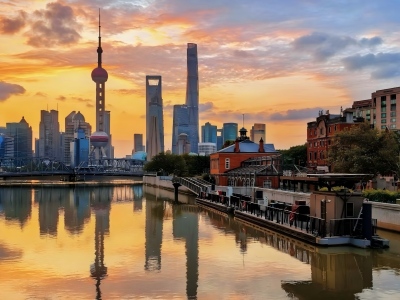
Your private driver will meet you at airport, train station or your hotel in Shanghai in the morning, holding a name sign for easy recognition. After a quick greeting, you'll step into a comfortable private vehicle and begin your one-day architecture journey through the city. There's no rush, no fixed group schedule—just a smooth, flexible start as we head into Shanghai's most iconic architectural districts.
The morning begins at the former Russian Orthodox cathedral, one of Shanghai's most overlooked architectural stories. From the outside, the onion domes already feel wildly different from the Shanghai skyline you probably imagined before arriving here. Your guide walks you through how thousands of Russian refugees arrived in Shanghai after the Russian Revolution, transforming entire districts with bakeries, nightclubs, churches and apartment houses that gave parts of the city an unexpectedly European atmosphere. Instead of simply saying "this is Byzantine style," your guide helps you actually see it. The layered arches, the vertical emphasis of the domes, the symbolic use of gold and light — suddenly the building stops looking like an exotic photo stop and starts making sense as a spiritual and political statement. You'll also hear why Orthodox churches in Shanghai had complicated histories after the 1940s and how many religious structures quietly disappeared during different political periods. It turns the church into something much more human than just "old architecture."Around the church area, your guide may point out surviving fragments of old Russian-era residences and street layouts that tourists usually pass without realizing their significance. Once you learn how to spot them, the city becomes much harder to look at casually.
From there, you move deeper into the former French Concession toward Wukang Road, where Shanghai architecture starts showing off a little. This is the part of the tour where the city feels cinematic without trying too hard. Plane trees arch over the streets, old garden villas hide behind ivy-covered walls, and nearly every corner has a different architectural personality competing for attention. Your guide does not treat Wukang Road like a simple "celebrity street." Instead, you'll learn how this district became a laboratory for international architectural styles during the 1920s and 1930s. Art Deco, Spanish Revival, French Renaissance influences and early modernist experimentation all ended up squeezed into a few walkable blocks because wealthy developers and foreign architects were essentially trying to outdo one another. At the famous Wukang Building, your guide helps you notice details that usually disappear behind selfie crowds — the wedge-shaped design adapting to the intersection, the subtle French apartment influences, the way balconies were designed for airflow long before air conditioning existed. Architecture here was not just about aesthetics. It was about status, climate, social hierarchy and modern urban living. As you continue walking, your guide naturally adjusts the pace depending on your interests. If you love photography, they know the quieter corners where afternoon light hits the facades beautifully. If you enjoy history, they'll point out which villas survived wartime occupation, political campaigns and real-estate redevelopment almost by accident.
Anfu Road feels like Shanghai loosening its tie a little. Compared with the grander atmosphere of Wukang Road, this area is more intimate and lived-in. The architecture here works quietly in the background while cafés, bookstores and old lane houses create the rhythm of daily life. What makes Anfu Road fascinating is not one landmark building, but the layering of eras. Your guide helps you notice how old lane-house structures were adapted into boutiques and cafés without completely erasing their original bones. Some retain old wooden staircases, stained glass windows or narrow servant corridors that reveal how upper-middle-class Shanghai families once lived. This is also where architecture and modern Shanghai culture start blending together naturally. You might stop for coffee inside a restored villa while your guide explains why adaptive reuse became such an important part of Shanghai preservation culture. In many cities, old buildings either become museums or disappear entirely. Shanghai often does something messier and more interesting — it keeps them alive through reinvention.
Lunch is arranged nearby based on your pace and preferences. Instead of pushing you toward a rushed tourist set menu, your guide can recommend hidden local spots inside former residential compounds, elegant Shanghainese restaurants inside restored mansions or lighter café-style options if you prefer to continue walking comfortably through the afternoon.
After lunch, the tour continues toward Hengshan Road, where Shanghai's architectural mood becomes calmer and more refined. Compared with the busier energy of downtown districts, this area feels almost residential, though the buildings quietly reveal just how wealthy and internationally connected Shanghai once was. Here your guide explains how urban planning worked differently inside the former French Concession. Wider roads, tree-lined avenues and villa compounds reflected European planning ideas that contrasted sharply with the denser Chinese districts nearby. Once you understand this, the neighborhood suddenly feels less random and far more intentional.
Along Hengshan Road, you'll encounter elegant mansions, former diplomatic residences and hidden garden homes tucked behind walls that many visitors barely notice. Your guide shares stories about famous residents, wartime transformations and how many houses changed identities multiple times throughout the twentieth century. One villa may have been a private mansion, then a government office, then subdivided communal housing, before later becoming a boutique commercial space. Shanghai architecture rarely stays frozen in time. That constant reinvention is part of its character. The pacing here stays intentionally relaxed. Some of the best moments happen between destinations — spotting old wrought-iron gates, hearing jazz drifting from a restored building or discovering tiny architectural details that suddenly connect everything you've seen throughout the day.
By the time you arrive at the Shanghai Museum of Arts and Crafts, the tour naturally shifts from grand streets and urban planning into the finer details that gave old Shanghai its elegance. Housed inside a beautifully preserved European-style mansion, the building itself is already part of the experience before you even look at the exhibitions. Your guide helps bridge the relationship between architecture and craftsmanship here. Instead of treating decorative arts as separate from buildings, they explain how wood carving, stained glass, embroidery, furniture design and ornamental plasterwork shaped Shanghai's hybrid architectural identity. The mansion becomes a perfect example of how Western architectural structures and Chinese artistic traditions merged into something uniquely local. Inside, you'll also hear stories about Shanghai's artisan culture during the Republican era, when wealthy families commissioned handcrafted interiors to display social status and cosmopolitan taste. Suddenly details you noticed earlier on Wukang Road or Hengshan Road start making more sense because you now understand the craftsmanship behind them. Because this stop is indoors and quieter, it also creates a nice rhythm shift in the day after several walking sections. Your guide adjusts the timing naturally so the experience never feels exhausting or overloaded with information.
As the afternoon softens into evening, the tour finishes at Hengshan Fang, where old Shanghai architecture meets contemporary creative culture in one of the city's more understated redevelopment spaces. Rather than demolishing the original structures, the area preserves much of the historical atmosphere while giving the buildings new life through cafés, galleries, design studios and lifestyle spaces. Your guide explains why projects like this are controversial in Shanghai. Preservation sounds romantic until developers, residents, historians and businesses all want different futures for the same buildings. Walking through Hengshan Fang, you begin seeing Shanghai not as a city choosing between "old" and "new," but as a place constantly negotiating between memory and reinvention. This final stop also gives you space to slow down properly after a full day of architectural exploration. You might end with a drink inside a renovated historical building while your guide shares local recommendations for other hidden architectural corners around the city. By this point, you'll probably notice that Shanghai has completely changed the way you look at ordinary streets.
This private tour Shanghai experience is designed for travelers who enjoy cities beyond checklist sightseeing. Architecture here is not presented like a textbook. It becomes a way of understanding migration, politics, fashion, class, urban planning and everyday life across different eras of Shanghai history. Throughout the day, your private guide and driver keep everything flowing smoothly between hotel pickup, neighborhood transfers, walking routes and flexible breaks, allowing you to focus entirely on the city itself instead of logistics. More importantly, the experience stays conversational and personal. Questions turn into detours, details lead into stories, and sometimes the most memorable moments happen while standing in front of a doorway you almost would have walked past. By the end of the tour, Shanghai stops feeling like a collection of landmarks and starts feeling like a city you can actually read.


 Accommodation:
  Meal:
Meal: